
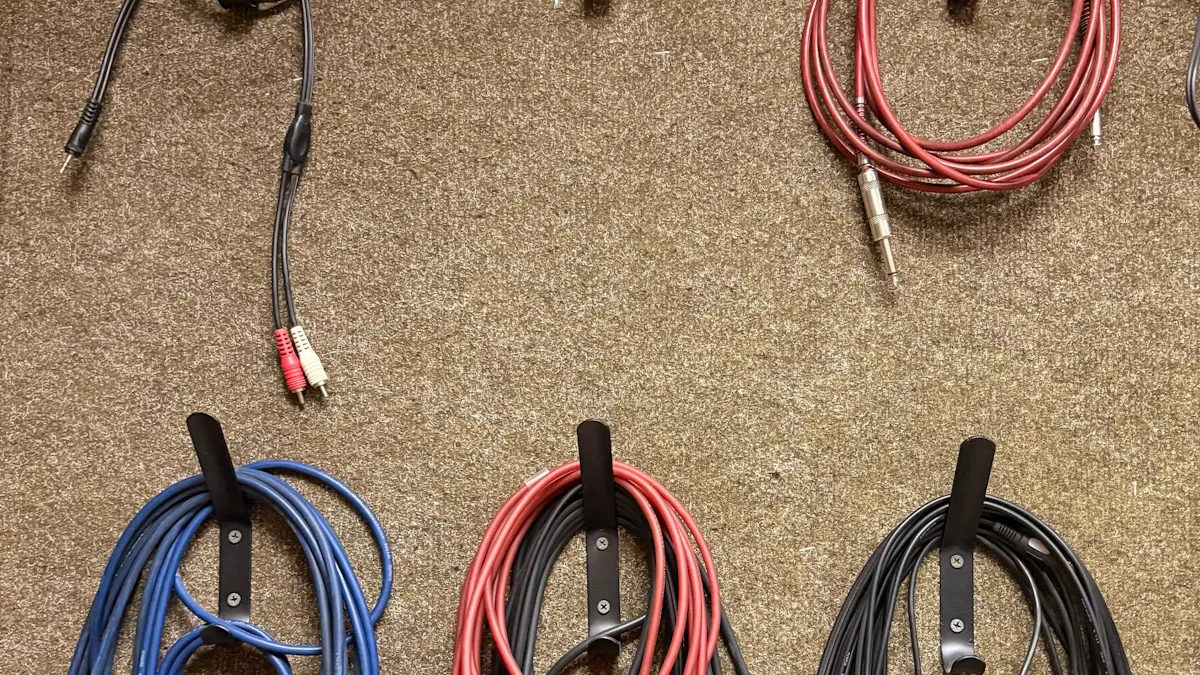
Balanced and unbalanced audio cables serve distinct purposes in audio transmission. A balanced audio cable utilizes a three-wire configuration, enhancing noise rejection in balanced cables and preserving signal integrity. In contrast, an unbalanced audio cable typically features a two-wire setup, making it more susceptible to interference.
These differences significantly affect audio performance. For instance, the balanced XLR cable advantages include providing clearer sound by minimizing distortion and noise, especially over longer distances. Conversely, unbalanced TS cable applications may introduce unwanted noise, impacting overall sound quality. Understanding these distinctions is essential for selecting the right cable for various professional sound system wiring scenarios.
Key Takeaways
- Balanced audio cables use three conductors, providing superior noise rejection and clearer sound, especially over long distances.
- Unbalanced audio cables have two conductors, making them more prone to interference and best suited for short runs under 20 feet.
- Choosing the right cable type is crucial; balanced cables excel in professional settings, while unbalanced cables work well for home audio.
- Consider cable length, signal type, and shielding when selecting audio cables to ensure optimal performance and sound quality.
- Using high-quality balanced cables can significantly enhance audio clarity and minimize unwanted noise in recordings.
Signal Theory
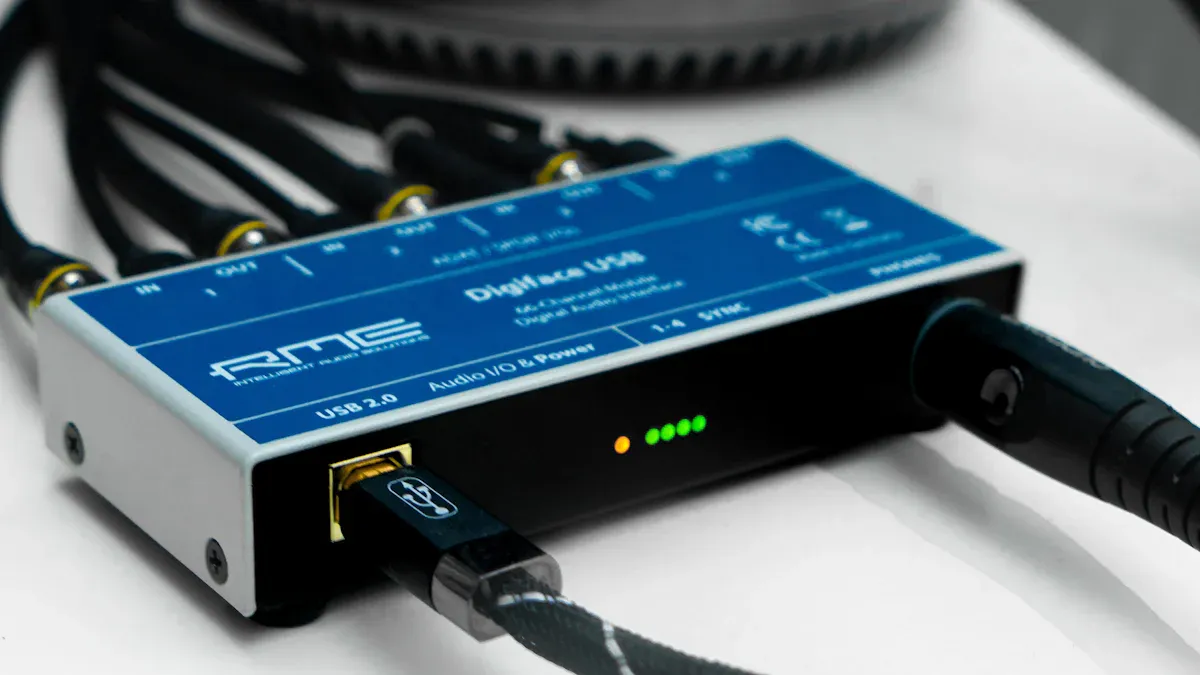
Balanced Audio Cable Definition
A balanced audio cable consists of three conductors: hot, ground, and cold. The cold signal mirrors the hot signal but inverts its phase. This configuration ensures equal impedance at both ends, which is crucial for maintaining signal integrity. The process of common-mode rejection occurs when the signals are inverted again at the input, effectively canceling out noise. This design allows balanced cables to excel in environments with high electromagnetic interference, making them ideal for professional audio applications.
Unbalanced Cable Definition
Unbalanced audio cables feature two conductor wires: a hot wire that transmits the audio signal and a common ground wire that is insulated. This configuration makes unbalanced cables more susceptible to noise, particularly over longer distances. They typically work best for shorter runs, ideally under 25 feet. In contrast to balanced cables, unbalanced cables have only two wires, meaning the negative wire serves a dual purpose as both the negative and ground. This leads to less effective noise cancellation compared to balanced configurations.
Signal Transmission in Balanced Cables
Signal transmission in balanced cables involves a differential connection. XLR balanced cables utilize a design that includes two signal wires and one ground wire. The two signal wires carry the same audio information but with opposite polarity. This arrangement allows balanced cables to effectively eliminate noise through common-mode rejection. When identical noise affects both wires, it cancels out when one signal is inverted.
The benefits of this design are measurable. Balanced connections enhance noise resistance because interference typically affects the signal wires equally. As a result, the amplifier only amplifies the difference between the two signals. This means that when noise enters the cable, it is canceled out, allowing the output to contain only the original audio signal. In professional audio applications, balanced cables route signals to reduce common-mode interference from sources of radio frequency noise, such as fluorescent lights and motors.
Signal Transmission in Unbalanced Cables
Unbalanced audio cables transmit signals using a simpler design than their balanced counterparts. They consist of two conductors: one carries the audio signal, while the other serves as a ground. This configuration, while straightforward, introduces several challenges.
The primary limitation of unbalanced cables lies in their susceptibility to interference. Here are some key points regarding their signal transmission:
- Single Conductor Design: Unbalanced cables utilize a single core for audio transmission. This design makes them more vulnerable to external noise and interference.
- Signal Loss Over Distance: Unbalanced cables experience a higher degree of signal loss over longer runs. Typically, they perform well only for distances up to 20 feet. Beyond this length, users may notice a decline in audio quality.
- Electromagnetic and Radio Frequency Interference: Unbalanced connections are particularly prone to electromagnetic interference (EMI) and radio frequency interference (RFI). These interferences can introduce unwanted hum, buzz, or hiss into the audio signal, especially in environments with many electronic devices.
- Noise Pickup: As unbalanced cables lack the noise-canceling features of balanced cables, they can easily pick up interference. This issue becomes more pronounced in professional audio settings, where clarity is crucial.
Noise and Interference
Noise Handling in Balanced Audio Cables
Balanced audio cables excel at mitigating external electrical interference. Their design incorporates two conductor wires along with a ground wire. This configuration allows them to cancel out any external noise that could disrupt the audio signal. The common-mode rejection feature significantly enhances their ability to maintain audio clarity, especially in environments with high electromagnetic interference. As a result, balanced cables can achieve noise rejection improvements of up to 80 dB in high-performance applications.
Noise Handling in Unbalanced Cables
Unbalanced cables struggle with noise management compared to their balanced counterparts. They typically achieve a noise rejection improvement of only around 30 dB. This limitation arises because ground noise flows directly into the shield conductor, making unbalanced cables more susceptible to interference. The table below summarizes the noise rejection capabilities of different cable types:
| Cable Type | Noise Rejection Improvement | Notes |
|---|---|---|
| Unbalanced | ~30 dB | Ground noise flows in the shield conductor. |
| Balanced (High-Performance) | ~80 dB | Using an input transformer or InGenius IC significantly improves rejection. |
| High-Quality Isolator | ~100 dB at 60 Hz, ~65 dB at 3 kHz | Internal Faraday shield enhances performance. |
| General Findings | Virtually impossible to achieve state-of-the-art audio performance with unbalanced interfaces. | Larger advantages in real-world scenarios due to ground loops and interference. |
Real-World Interference Examples
In practical settings, unbalanced cables face numerous interference challenges. Common sources of noise include electromagnetic interference (EMI) and radio frequency interference (RFI). These interferences often stem from power cables, lighting systems, and wireless devices.
Additionally, ground loops and galvanic connections can introduce significant audio interference, particularly in systems with multiple devices connected via unbalanced interconnect cables. Variations in cable design, such as different grounding strategies and shielding methods, can also affect susceptibility to EMI. Environmental factors like crosstalk and parasitic currents further complicate the performance of unbalanced cables, leading to voltage drops that disrupt audio signals.
By understanding these noise handling capabilities, audio professionals can make informed decisions about cable selection based on their specific needs.
Real-World Performance
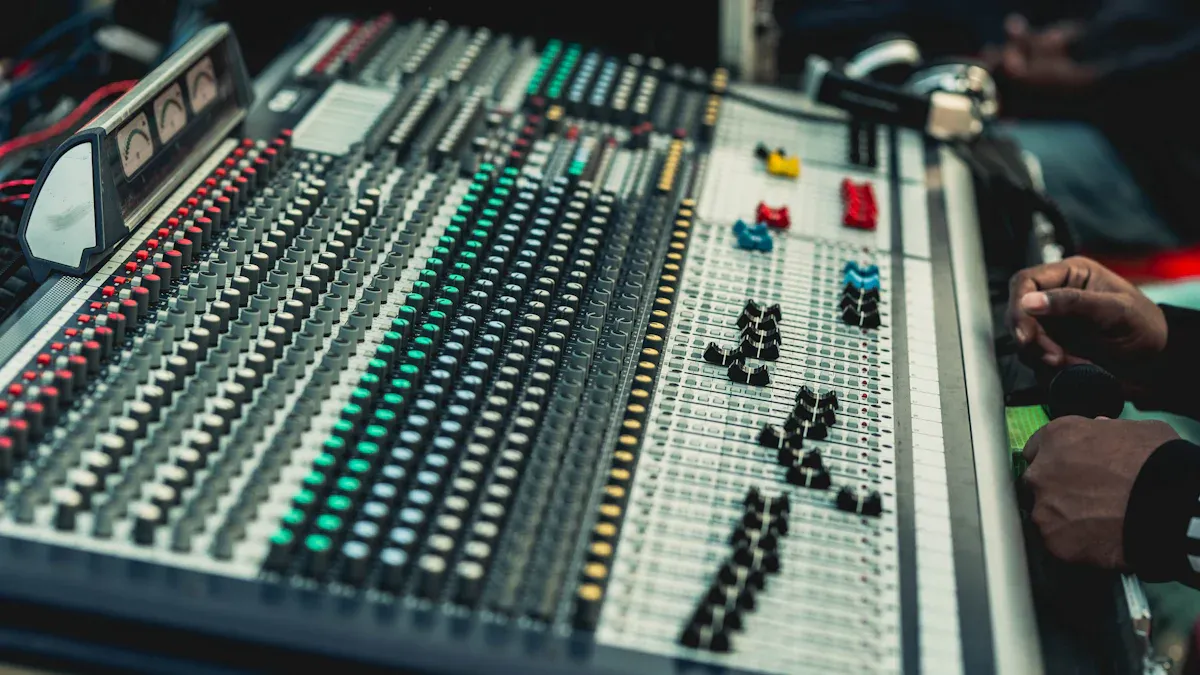
Studio Applications
In professional studios, the choice between balanced and unbalanced audio cables significantly impacts sound quality. Balanced audio cables are essential for maintaining high fidelity in recordings. They provide superior noise rejection, which is crucial in environments where interference can distort audio signals.
- State-of-the-Art Performance: Achieving optimal audio quality with unbalanced interfaces is virtually impossible. Balanced cables excel in real-world conditions, especially when dealing with ground loops and RF interference.
- Noise Abatement: Balanced cables enhance the signal-to-noise ratio (SNR), leading to clearer recordings. They maintain channel separation and signal integrity, effectively reducing hum and buzzing.
- Long-Distance Capability: XLR cables, a type of balanced audio cable, work exceptionally well over longer distances. Their phase-cancellation design actively rejects external noise, ensuring signal purity even when transmitting audio over significant lengths.
Choosing the Right Cable
Key Factors to Consider
When selecting audio cables, several factors influence the decision. Understanding these factors helps ensure optimal audio performance. Here are some key considerations:
- Cable Length: Unbalanced cables should remain short, ideally under 15-20 feet. Longer lengths increase the risk of interference. In contrast, balanced cables excel over longer distances, preserving signal integrity.
- Signal Type: Different cables serve specific purposes. For example, TS cables are suitable for mono signals, while TRS cables can handle both mono and stereo. Knowing the signal type helps in choosing the right cable.
- Cable Gauge and Shielding: The gauge affects the cable’s ability to carry signals without quality loss. Proper shielding is essential in environments with electronic interference. These factors are critical for professional audio applications.
In summary, balanced and unbalanced audio cables differ significantly in design and performance.
- Balanced cables feature three conductors, offering excellent noise rejection. They are ideal for professional studios and long-distance applications.
- Unbalanced cables, with only two conductors, provide poor noise rejection and are best suited for home audio and short runs.
Understanding these differences is crucial for achieving optimal audio performance. High-quality cables enhance sound clarity and minimize interference. As noted, "The best sound quality is typically achieved with balanced audio cables such as XLR or TRS cables, which are designed to minimize noise and interference over long distances."
By selecting the appropriate cable type, audio professionals can ensure clear and reliable sound reproduction.
FAQ
What is the main difference between balanced and unbalanced cables?
Balanced cables use three conductors to reduce noise, while unbalanced cables use two conductors. This difference affects their performance, especially over long distances.
When should I use balanced cables?
Use balanced cables in professional settings, such as studios and live sound environments. They excel in minimizing noise and maintaining audio quality over longer distances.
Can I use unbalanced cables for long distances?
Unbalanced cables are best for short runs, typically under 20 feet. Beyond this length, they may introduce unwanted noise and signal degradation.
Are there specific connectors for balanced and unbalanced cables?
Yes, balanced cables often use XLR or TRS connectors, while unbalanced cables typically use TS connectors. Each connector type serves its respective cable design.
How can I tell if my audio equipment requires balanced or unbalanced cables?
Check the input and output specifications of your audio equipment. If it supports balanced connections, use balanced cables for optimal performance. Otherwise, unbalanced cables may suffice.


