
Introduction
Audio cable shielding plays a direct role in keeping recorded and reproduced sound clean, especially in environments filled with power lines, wireless devices, and digital equipment. When a cable picks up electromagnetic or radio-frequency interference, that unwanted energy can enter the signal path as hum, buzz, or loss of detail. This article explains how shielding works as a protective barrier around the conductors, why different noise sources affect audio differently, and what that means for real-world cable performance. With that foundation, it becomes easier to understand which shielding methods improve signal quality and when they matter most.
Why Audio Cable Shielding Matters for Signal Quality
In professional audio engineering, preserving signal integrity from source to destination is paramount. Audio cables can act as antennas, inadvertently capturing ambient electromagnetic and radio-frequency energy from the surrounding environment. Without adequate shielding, these parasitic signals merge with the primary audio signal, resulting in audible distortion, hum, and a degraded dynamic range.
Shielding serves as a critical defense mechanism, creating a conductive barrier around the internal signal conductors. By intercepting external interference and shunting it to ground before it can penetrate the core wire, shielding preserves the fidelity of low-voltage audio transmissions. This physical barrier is especially critical in modern production environments, which are heavily saturated with wireless devices, high-current power cables, and digital processors.
How electromagnetic and radio-frequency noise affect audio signals
The degradation of audio signals typically originates from two primary categories of interference: Electromagnetic Interference (EMI) and Radio Frequency Interference (RFI). EMI is predominantly generated by low-frequency sources, such as power transformers, electric motors, and 50/60 Hz mains power lines. When an unshielded audio cable runs parallel to a power line, the alternating magnetic field induces an unwanted current in the audio conductors, manifesting as a low-frequency hum or buzz.
Conversely, RFI involves higher frequencies ranging from 100 kHz up to several GHz. Sources include Wi-Fi routers, mobile phones, broadcast antennas, and LED lighting ballasts. Because high-frequency waves have shorter wavelengths, they can penetrate cables with inadequate shielding coverage. Once induced, RFI often demodulates within the audio equipment’s input stage, producing unpredictable artifacts, high-pitched whining, or even audible radio broadcasts. The shielding acts as a Faraday cage, absorbing these radiated fields and converting them into minute electrical currents that are safely diverted to the system ground.
Why shielding impacts noise floor and reliability
The presence and quality of cable shielding directly dictate a system’s noise floor—the baseline level of unwanted signals and interference within a system. In critical recording and broadcast environments, achieving a noise floor of -110 dB or lower is often required to capture the full dynamic range of high-resolution digital audio. Inadequate shielding can elevate the noise floor to -70 dB or worse, masking subtle acoustic details and introducing a constant hiss that degrades the final mix.
Beyond acoustic purity, shielding dictates the operational reliability of an audio network. In live sound reinforcement or complex studio routing matrices, a compromised shield can lead to intermittent signal dropouts or sudden spikes in interference when lighting rigs or motors are activated. Reliable shielding ensures that the signal-to-noise ratio (SNR) remains stable regardless of fluctuating external environmental factors, guaranteeing consistent performance across thousands of hours of operation.
Types of Audio Cable Shielding
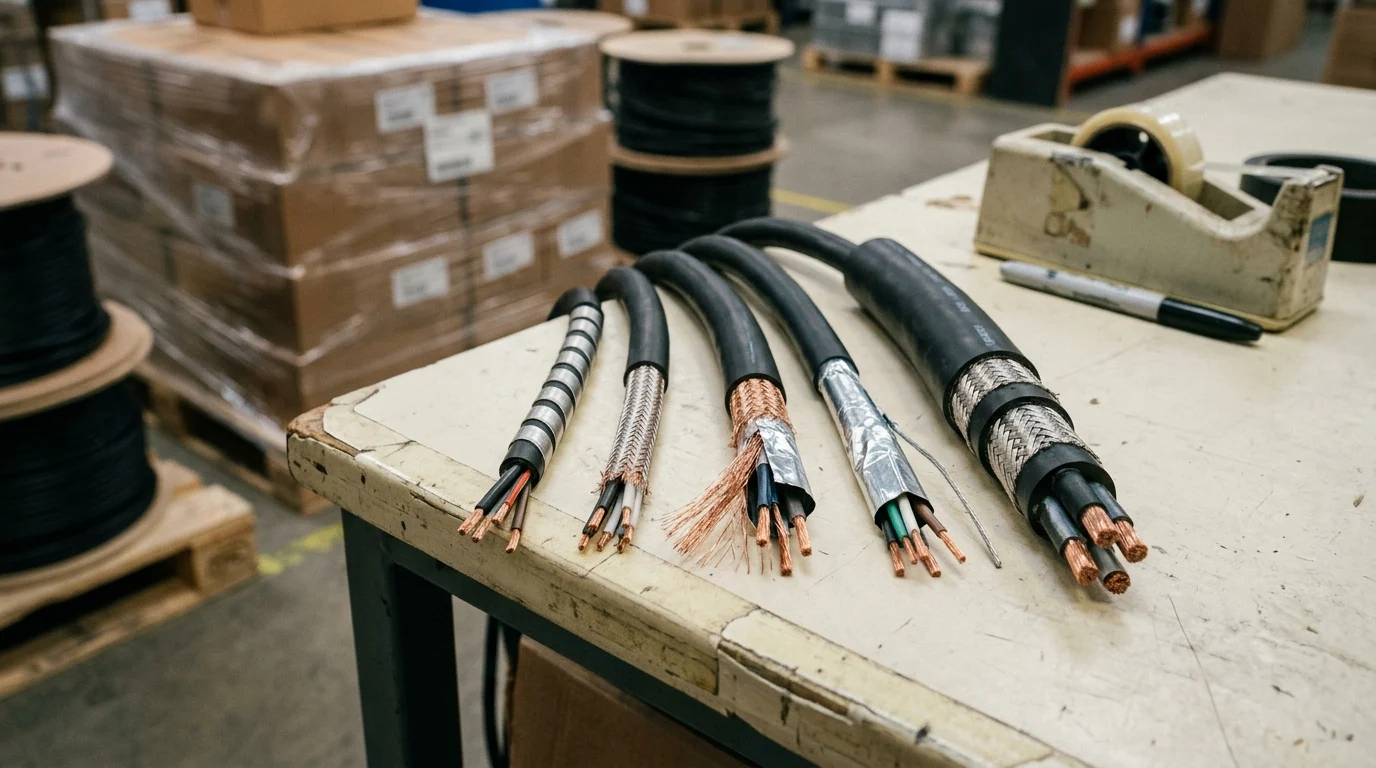
Audio cable manufacturers employ several distinct shielding topologies, each engineered to address specific interference profiles, mechanical requirements, and budgetary constraints. The physical construction of the shield dictates not only its electrical efficacy but also the cable’s flexibility, durability, and suitability for various deployment scenarios.
How foil, braided, spiral, and combination shields compare
The three most prevalent shielding designs in the audio industry are foil, braided, and spiral (serve) shields, occasionally combined to maximize performance.
| Shield Type | Construction Material | Typical Coverage | Mechanical Flexibility | Primary Interference Rejection |
|---|---|---|---|---|
| Foil | Aluminum/Mylar laminate | 100% | Low (prone to tearing) | Excellent for high-frequency RFI |
| Braided | Interwoven copper strands | 70% – 95% | Moderate to High | Excellent for low-frequency EMI |
| Spiral (Serve) | Parallel wrapped copper | 90% – 95% | Very High | Good for low-frequency EMI |
| Combination | Foil + Braided Copper | 100% | Low to Moderate | Superior broadband (EMI & RFI) |
Foil shields utilize a thin layer of aluminum laminated to a polyester backing (Mylar). While highly cost-effective and capable of providing 100% optical coverage, foil is fragile and degrades under repeated flexing. Braided shields consist of fine copper wires (typically 34 to 36 AWG) woven in intersecting meshes. This design offers superior structural integrity and high conductivity for shunting EMI, though it rarely exceeds 95% coverage due to the physical gaps in the weave. Spiral shields involve wrapping copper strands in a single direction around the core. This yields extreme flexibility and high coverage but can act as an inductor at very high frequencies, slightly reducing RFI efficacy.
Which cable constructions suit microphones and line-level runs
Matching the cable construction to the application is critical for both longevity and audio performance. Microphones demand highly flexible cables because they are constantly handled, moved, and coiled. Consequently, microphone cables almost exclusively utilize braided or spiral shields. The robust nature of braided copper prevents the shield from opening up or breaking during repeated physical stress, minimizing handling noise and structural failure.
Conversely, line-level runs in fixed installations—such as studio tie lines, analog snakes, or installed structural wiring—do not require flexibility once deployed. These applications heavily favor foil shielding. The 100% coverage provided by foil is ideal for rejecting the dense RFI found in walls and ceilings, while the lack of flexibility is irrelevant in a static environment. A drain wire is typically run parallel to the foil to ensure continuous ground contact, simplifying termination for installers.
What to compare in shielding performance and cost
When evaluating shielding performance, engineers must balance coverage percentages, material conductivity, and cost. A standard spiral-shielded instrument cable may cost as little as $0.80 per foot, providing adequate protection for short runs in low-noise environments. However, premium braided shields require significantly more copper and slower manufacturing processes, pushing costs to $2.00 or more per foot.
For mission-critical applications, combination shields (often termed double-shielded cables) represent the highest tier of performance. By layering a 100% coverage aluminum foil under an 85% coverage tinned copper braid, manufacturers achieve near-perfect broadband interference rejection. While this construction can increase cable costs to over $4.00 per foot and significantly reduce flexibility, the investment is necessary where maximum signal integrity is non-negotiable.
Shielding Design, Grounding, and Installation
Even the most advanced shielding construction is rendered ineffective if the underlying circuit design, grounding architecture, and physical installation practices are flawed. The relationship between the cable shield and the audio equipment’s grounding scheme determines whether intercepted noise is successfully dissipated or inadvertently injected into the audio path.
How balanced and unbalanced configurations change shielding needs
Audio connections are broadly categorized into unbalanced and balanced configurations, each interacting with cable shielding in fundamentally different ways. In an unbalanced configuration (such as standard TS instrument cables or RCA interconnects), the shield serves a dual purpose: it acts as the barrier against interference and simultaneously functions as the audio signal’s return path. Any noise current induced into the shield is mixed directly with the audio reference ground, making unbalanced runs highly susceptible to interference over distances greater than 15 to 20 feet.
Balanced configurations (utilizing XLR or TRS connectors) decouple the shield from the signal path. The audio signal is carried over two identical inner conductors twisted together (a twisted pair), transmitting identical signals in opposite polarity. The receiving equipment utilizes a differential amplifier to process the signal, yielding a Common Mode Rejection Ratio (CMRR) that typically rejects 60 to 80 dB of induced noise. In this topology, the shield is connected exclusively to the chassis ground, safely draining EMI and RFI without polluting the audio signal.
What installation practices reduce ground loops and induced noise
Improper installation can compromise shielding efficacy and introduce ground loops—a phenomenon where a voltage differential exists between the ground connections of two pieces of equipment, causing a 50/60 Hz hum to circulate through the cable shield. To mitigate this, engineers often employ a technique known as “telescoping the shield.” This involves connecting the shield to ground at the source end while leaving it disconnected (lifted) at the destination end. The shield still acts as an antenna for RFI, draining it at the source, but the broken physical connection prevents ground loop currents from flowing.
Physical routing also plays a critical role. When audio cables must intersect with high-voltage power lines, industry best practices dictate crossing them at exact 90-degree angles. Parallel runs of audio and power cables should be avoided; if unavoidable, maintaining a physical separation of at least 12 to 18 inches significantly reduces the strength of the magnetic field coupling into the audio shield.
Which specifications matter most
When specifying shielded audio cables, parasitic capacitance is a critical metric that must be evaluated alongside shielding coverage. Because a shield is a conductor separated from the inner signal wires by a dielectric insulator, the cable inherently acts as a capacitor. This capacitance is measured in picofarads per meter (pF/m).
High capacitance will create a low-pass filter effect, rolling off high-frequency audio content and dulling the sound. For long cable runs, engineers should seek cables with a core-to-shield capacitance of less than 100 pF/m. Premium low-capacitance cables often achieve specifications as low as 65 pF/m through the use of foamed polyethylene or Teflon dielectrics, ensuring that the shield protects against noise without degrading the transient response of the audio signal.
How to Choose the Right Audio Cable Shielding
Selecting the optimal audio cable shielding requires a systematic evaluation of the deployment environment, the physical demands placed on the cable, and the budgetary parameters of the project. Over-specifying shielding can lead to unnecessary expenses and unwieldy cables, while under-specifying can result in catastrophic signal degradation during critical performances.
What trade-offs to weigh between performance, durability, and cost
The selection process inherently involves balancing electrical performance, mechanical durability, and financial cost. Cables engineered for maximum RF rejection often sacrifice flexibility and durability.
| Application Environment | Primary Interference Threat | Recommended Shielding Topology | Expected Durability / Flex Cycles | Relative Cost Premium |
|---|---|---|---|---|
| Fixed Studio/Installation | Low-Frequency EMI | Foil (100% coverage) | Low (< 500 cycles) | Baseline (1x) |
| Live Stage / Touring | Physical stress, EMI | Spiral or Braided Copper | High (10,000+ cycles) | +30% to +50% |
| Broadcast / Dense RF | High-Frequency RFI | Double Shield (Foil + Braid) | Moderate (5,000 cycles) | +150% to +300% |
For touring applications, the mechanical strength of a braided shield justifies its higher cost, as the cable must survive being trampled, stretched, and tightly coiled daily. Conversely, a permanent studio installation prioritizing pristine audio over physical resilience benefits most from inexpensive, high-coverage foil shielding.
When premium shielding is justified
Premium shielding—such as double-braided or foil-plus-braid constructions—is justified when operating in highly volatile electromagnetic environments. Broadcast towers, theatrical stages with dense LED video walls, and venues adjacent to heavy industrial machinery generate massive amounts of broadband interference. In these scenarios, standard spiral shielding may allow high-frequency RF to bleed into the audio path.
Furthermore, premium shielding is essential for very low-level signals, such as those generated by passive ribbon microphones or phono cartridges. Because these devices output signals in the microvolt range, even a 2-millivolt noise induction can severely compromise the SNR. The investment in cables costing $3.00 to $5.00 per foot becomes a negligible insurance policy against ruined recordings or compromised live broadcasts.
What decision framework helps match shielding to the application
To consistently match shielding to the application, audio professionals should employ a structured decision framework. First, analyze the electrical environment: identify the presence of high-current power runs, wireless transmitters, or digital lighting ballasts. If RFI is the dominant threat, prioritize coverage percentage (foil or combination shields). If low-frequency magnetic EMI is the concern, prioritize shield mass and conductivity (braided copper).
Next, evaluate the mechanical requirements to determine if the cable will remain static or require the flexibility of a braided or spiral shield to withstand frequent handling.
Key Takeaways
- The most important conclusions and rationale for Audio Cable
- Specs, compliance, and risk checks worth validating before you commit
- Practical next steps and caveats readers can apply immediately
Frequently Asked Questions
Why is shielding important in an audio cable?
Shielding blocks EMI and RFI before they reach the conductors, reducing hum, buzz, and hiss. It helps maintain cleaner signal transfer in studios, live venues, and installations.
Which shield type is best for professional audio use?
It depends on the job. Braided shields handle low-frequency EMI well, foil shields excel against RFI, and foil plus braid offers the best all-around protection for demanding pro-audio systems.
When should I choose a better-shielded cable?
Use higher-shielded cables when runs are long or near power lines, LED lighting, Wi-Fi devices, dimmers, or motors. These environments raise noise risk and need stronger interference protection.
Can shielding improve microphone and line-level signal quality?
Yes. Mic and line-level signals are low voltage, so they pick up interference easily. Good shielding helps preserve detail, lowers the noise floor, and improves system reliability.
Does JINGYI offer shielded OEM/ODM audio cable solutions?
Yes. JINGYI provides OEM/ODM premade audio cables and connectivity solutions with OFC 99.99% copper conductors and ultra-low-noise shielding for studios, live sound, festivals, and cinemas.


