
Introduction
Speaker cable gauge affects more than fit and cost: it directly influences resistance, voltage drop, and how much power actually reaches your speakers over a given run. The right choice depends mainly on cable length and speaker impedance, with longer distances and lower-ohm loads generally requiring thicker wire. This article explains how AWG sizes relate to electrical loss, what “acceptable” resistance looks like in practical terms, and when common options like 16, 14, or 12 AWG make sense. By the end, you’ll be able to match cable gauge to your setup confidently and avoid overpaying or undersizing.
Why Speaker Cable Gauge Matters
The American Wire Gauge (AWG) system dictates the cross-sectional area of electrical conductors, establishing the foundational electrical relationship between an audio amplifier and a loudspeaker. For high-fidelity audio reproduction and commercial sound reinforcement, selecting the right gauge for speaker cable lengths is critical to maintaining signal integrity, maximizing dynamic range, and ensuring system stability. A mismatched conductor can compromise even the most advanced digital signal processing and premium transducer engineering.
Resistance, voltage loss, and amplifier load
Direct current (DC) resistance is the primary obstacle in analog audio transmission over distance. A thicker cable, denoted by a lower AWG number, presents less resistance to the electrical signal. Industry standards dictate that total cable resistance should not exceed 5% of the loudspeaker’s nominal impedance. For a standard 8-ohm speaker, the maximum acceptable total cable resistance is exactly 0.4 ohms. If resistance exceeds this threshold, insertion loss becomes highly audible.
Furthermore, the amplifier’s damping factor—its mechanical ability to control transducer motion—degrades significantly. Damping factor is calculated by dividing the loudspeaker impedance by the sum of the amplifier’s output impedance and the cable resistance. When cable resistance spikes due to insufficient gauge, the damping factor plummets, resulting in a loss of transient response and poorly controlled, boomy low frequencies where impedance dips typically occur.
Commercial risks of using the wrong gauge
In commercial installations, such as large-scale live sound deployments, stadium arrays, or cinema systems, undersized cables lead to severe power dissipation and tangible commercial risks. A 16 AWG cable carrying 1,000 watts over 100 feet to a 4-ohm subwoofer cluster will lose nearly 20% of its total power to heat generation caused by conductor resistance.
This not only diminishes the acoustic output by several decibels but also forces the amplifier module to work significantly harder to achieve target sound pressure levels. Over time, this constant strain risks premature amplifier clipping, thermal shutdown, and catastrophic hardware failure. Specifying the correct gauge during the design phase mitigates these operational hazards, eliminates the need for costly post-installation rewiring, and protects high-value capital equipment investments.
How to Compare Speaker Cable Gauge Options
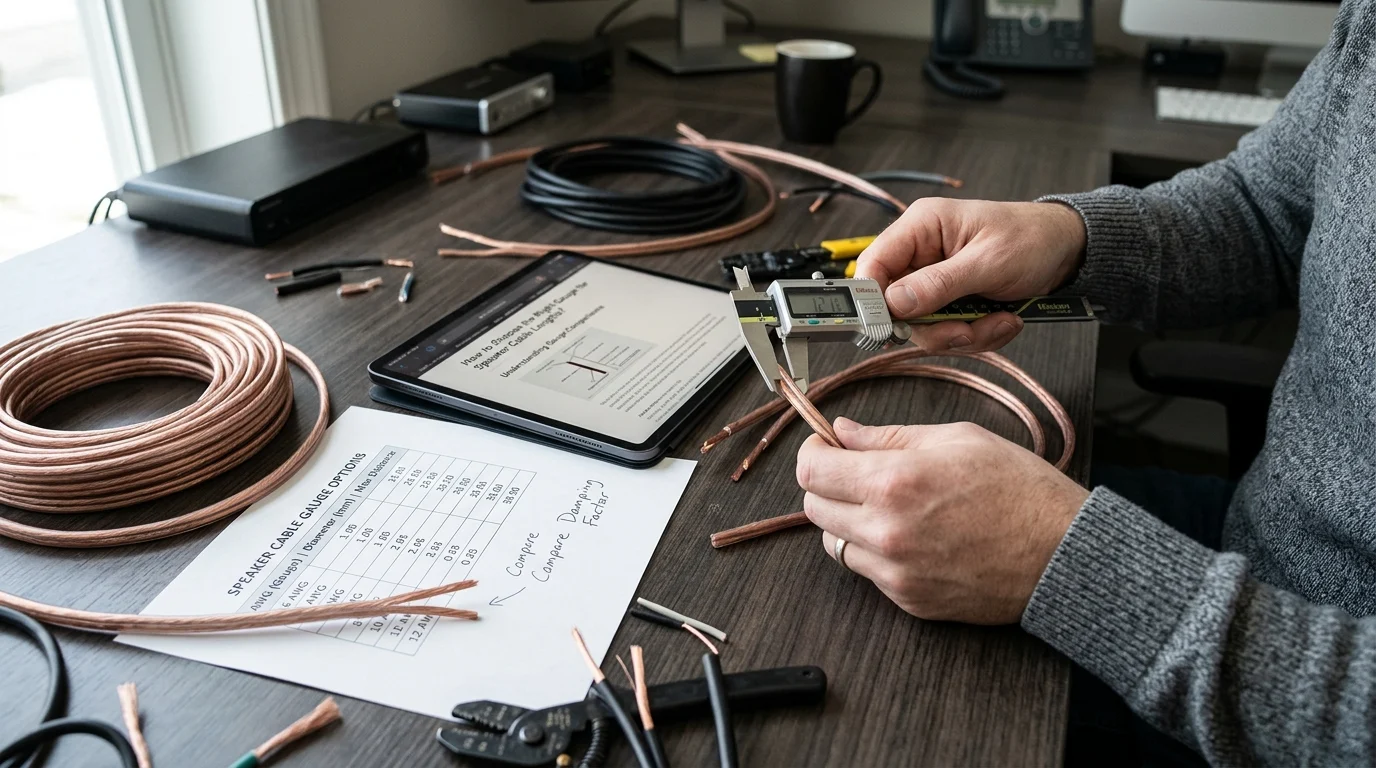
Comparing conductor options requires evaluating the electrical demands of the specific installation alongside the physical and chemical properties of the cable. While the primary metric for comparison is the AWG rating, variables such as material purity, strand geometry, and insulation type heavily influence overall performance, particularly over extended cable runs where signal degradation is most likely to occur.
Speaker cable length and AWG comparison
The relationship between load impedance, cable length, and conductor thickness determines the exact point at which signal loss becomes unacceptable. Because the audio signal must travel to the speaker and back to the amplifier, calculations must account for the total round-trip distance of the conductor. The table below outlines the maximum recommended one-way cable lengths to maintain less than 0.5 dB of insertion loss, ensuring optimal power transfer.
| AWG Rating | Max Length (4-ohm load) | Max Length (8-ohm load) | DC Resistance (per 1000 ft) |
|---|---|---|---|
| 10 AWG | 100 feet (30.5 m) | 200 feet (61.0 m) | 0.99 ohms |
| 12 AWG | 60 feet (18.3 m) | 120 feet (36.6 m) | 1.58 ohms |
| 14 AWG | 40 feet (12.2 m) | 80 feet (24.4 m) | 2.52 ohms |
| 16 AWG | 24 feet (7.3 m) | 48 feet (14.6 m) | 4.01 ohms |
| 18 AWG | 15 feet (4.6 m) | 30 feet (9.1 m) | 6.38 ohms |
System engineers must reference these baseline thresholds to prevent current bottlenecks. As the loudspeaker impedance drops, the cable must be correspondingly thicker to carry the increased current without introducing detrimental resistive losses.
Material, strand count, and insulation quality
Beyond thickness, conductor material is a paramount consideration. Oxygen-Free Copper (OFC) remains the industry standard for professional audio, offering superior conductivity and corrosion resistance. Conversely, Copper-Clad Aluminum (CCA) exhibits approximately 60% higher DC resistance than pure copper. Consequently, a 14 AWG CCA cable performs electrically similarly to a 16 AWG OFC cable, requiring engineers to upsize the gauge by at least two steps if specifying CCA to achieve identical performance.
Strand count impacts mechanical flexibility for touring applications but does not significantly alter the skin effect at standard audio frequencies (20 Hz to 20 kHz). Furthermore, insulation quality dictates commercial code compliance; installations routing through return-air spaces necessitate plenum-rated (CMP or CL2P) jackets featuring low-smoke, fire-retardant materials like FEP or Teflon, which also present lower parasitic capacitance than standard PVC.
How to Choose the Right Gauge
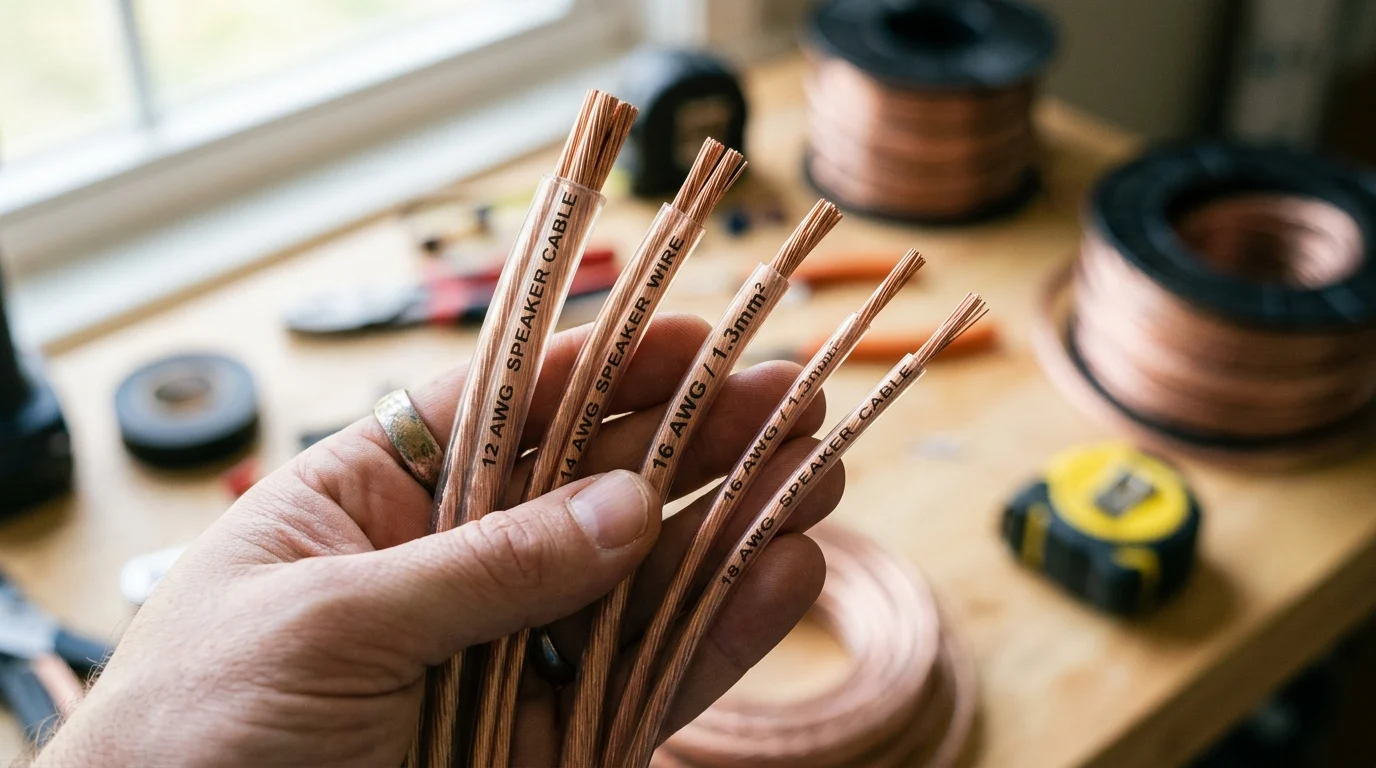
The methodology for selecting the appropriate conductor must account for the loudspeaker’s minimum operational impedance, the total routing distance, and the environmental constraints of the venue. A systematic, mathematically driven approach prevents both costly over-specification of heavy copper and the detrimental performance impacts of under-specification.
Step-by-step selection process
First, determine the nominal and minimum impedance of the loudspeaker; an 8-ohm nominal speaker may exhibit severe impedance dips down to 3.2 ohms at specific crossover frequencies, requiring a thicker cable to handle sudden, frequency-dependent current demands. Second, measure the exact cable run length from the amplifier rack to the speaker terminals, adding a strict 10% margin for routing slack, service loops, and termination.
Third, calculate the maximum allowable cable resistance, targeting less than 5% of the speaker’s lowest impedance point. Finally, cross-reference this maximum resistance against standard AWG resistance charts. For example, if the maximum allowable resistance is 0.3 ohms and the physical run is 100 feet (requiring 200 feet of total conductor for the positive and negative legs), the cable must have a resistance lower than 1.5 ohms per 1,000 feet. This calculation strictly dictates the use of 10 AWG or 12 AWG wire to maintain signal integrity.
Final decision guidelines
To streamline procurement and installation, industry professionals adhere to established guidelines based on application scale and termination hardware, ensuring the
Key Takeaways
- The most important conclusions and rationale for Right Gauge for Speaker Cable
- Specs, compliance, and risk checks worth validating before you commit
- Practical next steps and caveats readers can apply immediately
Frequently Asked Questions
What speaker cable gauge should I use for long runs?
Use thicker cable as runs increase: 16 AWG up to 24 ft at 4 ohms, 14 AWG to 40 ft, 12 AWG to 60 ft, and 10 AWG to 100 ft.
Does speaker impedance affect the right cable gauge?
Yes. Lower-impedance speakers draw more current, so they need thicker cable. A 4-ohm speaker typically needs one heavier gauge than an 8-ohm speaker at the same length.
Why does cable length matter for speaker performance?
Longer cable adds resistance, causing power loss, weaker damping, and softer bass control. Keep total cable resistance under about 5% of the speaker’s nominal impedance.
Is OFC copper better for speaker cables?
Yes. 99.99% OFC copper offers lower resistance and better long-run reliability than cheaper conductors, making it a practical choice for hi-fi, live sound, and cinema installs.
Can JINGYI supply custom speaker cables for OEM or projects?
Yes. JINGYI provides premade and OEM/ODM speaker cable solutions, including custom lengths, connectors, and private-label production for studios, live venues, festivals, and cinemas.


