

Introduction
Balanced audio depends on three conductors carrying hot, cold, and shield signals so external noise can be canceled at the input stage. In that context, 6.35mm TRS and XLR can deliver the same balanced signal quality, but they differ in how they behave in real equipment and real workflows. This comparison focuses on where 6.35mm TRS fits best, especially in patch bays, rack gear, mixers, and space-constrained panels. You’ll see how connector design affects contact stability, hot-plug behavior, durability, and installation density, making it easier to choose the right format based on practical engineering trade-offs rather than assumptions about sound quality.
Why XLR vs 6.35mm TRS Matters
Balanced audio transmission relies on phase cancellation to eliminate electromagnetic interference (EMI) and radio frequency interference (RFI), a critical requirement for professional acoustic environments. Both XLR and 6.35mm TRS connectors serve as the foundational interfaces for these balanced lines. While they transfer identical differential signals, their mechanical architectures serve entirely different operational philosophies.
Choosing between an XLR and a 6.35mm TRS connector is rarely a matter of audio fidelity, but rather a strategic decision based on mechanical robustness, panel density, and electrical safety during hot-plugging. Understanding the engineering trade-offs between these formats ensures optimal signal integrity and hardware longevity.
Impact on Noise and Reliability
The primary function of a balanced interconnect is to maintain a high Common Mode Rejection Ratio (CMRR), often exceeding 60 to 80 dB in professional-grade analog equipment. Both XLR and 6.35mm TRS connectors utilize three discrete conductors—positive (hot), negative (cold), and ground (shield)—to transmit the audio signal alongside its inverted duplicate. When the receiving differential amplifier recombines the signals, any noise induced along the cable is rejected.
From a reliability standpoint, the mechanical design of the connector dictates its vulnerability to noise introduced by physical movement. XLR connectors utilize a locking latch mechanism and a deeply recessed pin structure, isolating the contacts from external shock. Conversely, 6.35mm TRS connectors rely on friction-fit spring contacts, which are highly effective in static racks but present a higher risk of momentary disconnects if the cable is subjected to lateral tension.
Where Each Connector Is Commonly Used
The distinct form factors of these connectors have naturally segregated them into specific industry domains. XLR is the undisputed standard for microphone-level signals, handling low-impedance loads typically ranging from 150 to 600 ohms. Its rugged housing and locking mechanism make it ubiquitous on live sound stages, broadcast studios, and field recording environments where cables are frequently stepped on or pulled.
The 6.35mm TRS connector dominates the realm of line-level routing. Operating at standard +4 dBu professional line levels, TRS is the connector of choice for studio patchbays, synthesizers, outboard dynamic processors, and active studio monitors. Its linear, plug-style design allows for rapid repatching, making it indispensable in high-density studio environments where dozens of routing changes are required during a single session.
Key Differences Between XLR and 6.35mm TRS

While both formats achieve the same end goal in balanced audio transmission, their internal geometries and electrical mating sequences differ significantly. These structural disparities directly influence their suitability for specific analog and digital audio applications.
Pinout, Contact Design, and Shielding
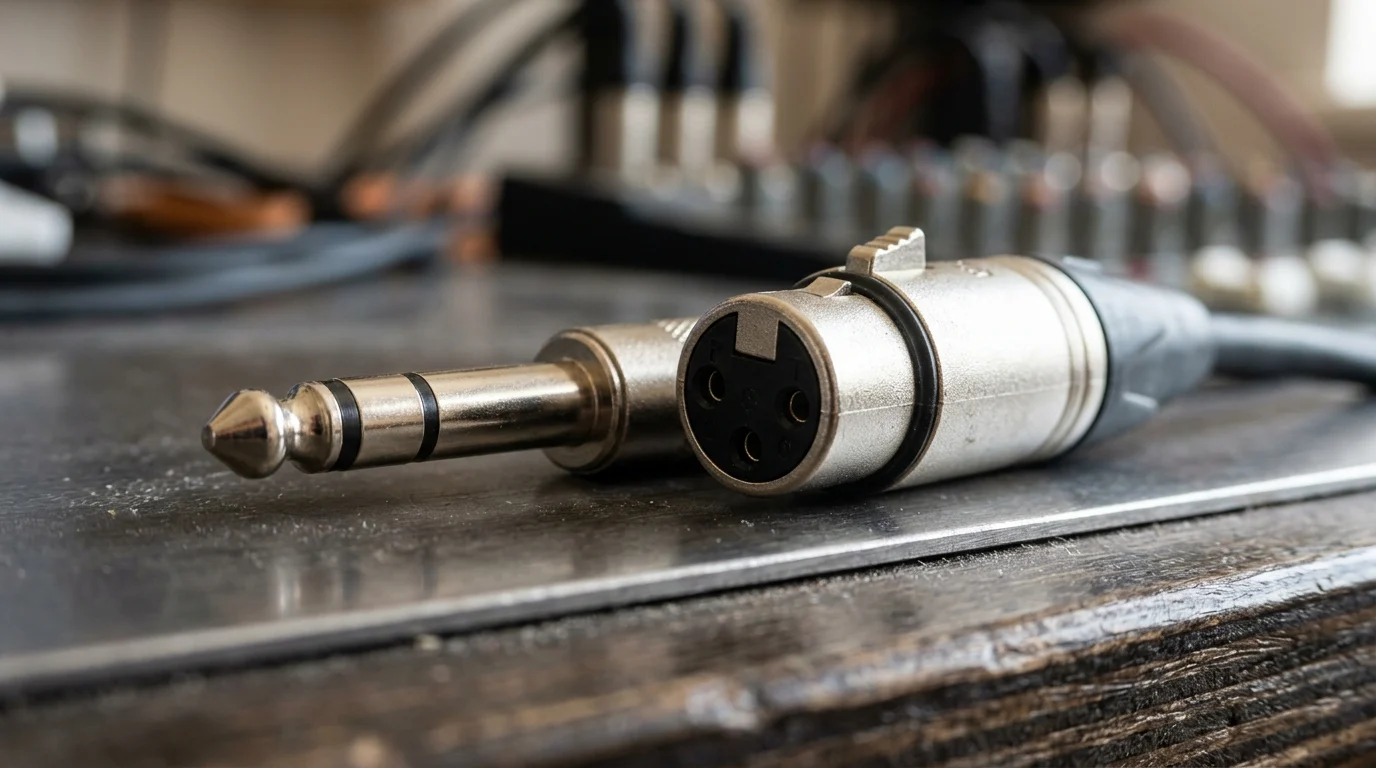
The XLR connector features a circular shell housing three distinct pins (for male) or sockets (for female). The AES14 standard dictates the pinout: Pin 1 is ground (shield), Pin 2 is positive (hot), and Pin 3 is negative (cold). A critical engineering advantage of the XLR design is its mating sequence. Pin 1 is typically manufactured to be 2mm longer than Pins 2 and 3. This ensures that the ground connection is established before the signal pins make contact, effectively preventing transient voltage spikes or “pops” when connecting active equipment.
The 6.35mm TRS connector utilizes a coaxial design divided into three segments: Tip (positive/hot), Ring (negative/cold), and Sleeve (ground/shield). Unlike XLR, the TRS plug inserts into a jack linearly, meaning the tip must pass through the sleeve and ring contacts of the receptacle before seating. This momentary bridging can short the signal to ground or cross-connect hot and cold lines during insertion, making TRS less ideal for hot-plugging active circuits with high gain.
When TRS Matches XLR for Balanced Audio
Electrically, once fully seated in a permanent or semi-permanent installation, a high-quality 6.35mm TRS connection matches the performance of an XLR connection. Both will pass a balanced +4 dBu line-level signal with identical frequency response and CMRR.
In controlled environments where cables are not subjected to movement, the structural differences become acoustically negligible. High-end outboard gear often features both TRS and XLR inputs wired in parallel to the exact same differential receiver circuit, yielding zero measurable difference in Total Harmonic Distortion plus Noise (THD+N) or signal-to-noise ratio.
Balanced Audio Performance Comparison
To quantify the engineering differences between professional-grade XLR and 6.35mm TRS connectors, standard electromechanical specifications are compared below. These metrics assume premium connectors from industry-standard manufacturers.
| Specification | XLR (3-Pin) | 6.35mm TRS (1/4-inch) |
|---|---|---|
| Contact Resistance | < 3 mΩ | < 5 mΩ |
| Dielectric Strength | 1.5 kVdc | 1.0 kVdc |
| Rated Current per Contact | 16 A | 10 A |
| Mating Cycles (Lifespan) | > 1,000 cycles | > 1,000 cycles |
| Ground-First Mating | Yes (Pin 1 advances) | No (Linear insertion) |
| Locking Mechanism | Standard (Push-latch) | Rare (Requires specialty jack) |
The data illustrates that while both connectors offer excellent longevity, XLR provides superior current handling and dielectric strength. This higher tolerance makes XLR safer for carrying phantom power, while TRS’s lower contact resistance threshold is perfectly adequate for standard line-level voltages.
How Application and Environment Affect the Choice
Environmental factors—ranging from the physical constraints of a server rack to the chaotic foot traffic of a live concert—play a dominant role in specifying audio connectors. The mechanical envelope of the connector often outweighs electrical theory when designing audio infrastructure.
Why XLR Is Preferred for Microphones and Stage Use
The live stage environment demands fault tolerance. Microphones require +48V DC phantom power to polarize condenser capsules and power active circuitry. Because XLR establishes a ground connection first, it safely discharges static and properly references the 48V supply before the audio lines mate, protecting delicate microphone ribbons and preamp input stages from catastrophic voltage transients.
Furthermore, standard XLR latches are rated to withstand 20 to 30 lbs (89 to 133 Newtons) of axial pull force. This locking capability ensures that a vocalist stepping on a microphone cable or a stagehand tripping over a snake will not inadvertently disconnect the audio feed mid-performance. The robust outer shell also acts as a Faraday cage, providing superior EMI shielding directly at the mating point.
Why TRS Is Common for Patchbays and Line-Level Gear
In recording studios and broadcast facilities, rack space is a premium commodity. The footprint of an XLR panel-mount receptacle is significantly larger than that of a 6.35mm TRS jack. A standard 1U (1.75-inch) 19-inch equipment rack can comfortably accommodate 48 to 96 TRS or Bantam (TT) patch points. In contrast, the same 1U space is physically limited to a maximum of 16 standard D-series XLR cutouts.
This density makes TRS the only viable option for comprehensive analog routing matrices. Because patchbays handle line-level signals rather than low-level mic signals requiring phantom power, the lack of a locking mechanism and ground-first mating is an acceptable trade-off for the massive increase in routing density.
Effects of Cable Length, Vibration, and Repeated Use
Cable length and environmental vibration heavily influence connector choice. For long cable runs extending over 100 feet (30 meters)—such as those from a stage to a front-of-house mixing console—XLR is mandatory. The locking mechanism prevents vibration from loosening the connection over time, which can degrade the ground contact and introduce hum.
Repeated use in high-vibration environments causes friction-fit TRS contacts to fatigue faster than the heavy-duty fork-and-blade style contacts of an XLR. While high-quality TRS jacks utilize beryllium copper springs to maintain a retention force of roughly 10 to 15 Newtons, sustained vibration can cause micro-arcing and oxidation on the tip and ring surfaces, raising contact resistance and degrading the balanced signal.
Procurement and Compatibility Considerations
For equipment manufacturers and systems integrators, the choice between XLR and 6.35mm TRS impacts the Bill of Materials (BOM), supply chain logistics, and overall product versatility. Sourcing the correct components requires balancing unit cost against long-term reliability and interoperability.
Cost, Availability, and Build Quality
XLR connectors carry a higher manufacturing cost due to their complex multi-part assembly, which includes a die-cast zinc shell, internal strain relief chucks, and locking latches. At a standard Minimum Order Quantity (MOQ) of 1,000 units, premium XLR receptacles typically cost between $3.00 and $5.00 per unit. In contrast, equivalent high-cycle 6.35mm TRS jacks range from $1.50 to $3.00 per unit.
Availability for both formats is exceptionally high, with established supply chains across major global distributors. However, the build quality of TRS jacks varies more wildly than XLRs. Low-cost TRS jacks often use stamped steel contacts rather than machined brass or beryllium copper, which can reduce the mating lifecycle from 10,000 cycles down to fewer than 1,000 before retention force fails.
Interoperability Risks with Combo Jacks and Insert Points
To maximize panel space and offer flexibility, many manufacturers utilize combo jacks (such as the Neutrik Combo I series), which integrate an XLR receptacle and a 6.35mm TRS jack into a single housing. While highly efficient, these can introduce interoperability risks. The TRS portion of a combo jack is often routed to a line-level pad, while the XLR portion routes directly to the microphone preamp.
Another interoperability risk arises from unbalanced insert points. Many mixing consoles use a single TRS jack to handle both send and return signals (Tip = Send, Ring = Return, Sleeve = Ground). Novice users frequently mistake these unbalanced insert points for balanced TRS inputs or outputs, leading to phase cancellation, 6 dB signal drops, or severe ground loops when interfaced improperly with balanced gear.
Specifications and Inspection Checks
When auditing components for procurement, engineers must verify specific tolerances to ensure compliance with professional audio standards. Inspection checks should focus on contact plating, insertion force, and insulation resistance.
| Inspection Parameter | Target Specification (Professional Grade) | Failure Indication |
|---|---|---|
| Insertion/Withdrawal Force | < 20 N (XLR) / 10-20 N (TRS) | Excessive wear on mating equipment |
| Insulation Resistance | > 2 GΩ (Initial) | Leakage current, crosstalk |
| Contact Plating | 2 µm Silver or 0.2 µm Gold | Rapid oxidation, increased THD |
| Solderability | Complies with IEC 68-2-20 | Weak cold solder joints during assembly |
| Temperature Range | -30°C to +80°C | Plastic deformation of internal insulator |
Gold plating is highly recommended for TRS patchbays where low-voltage line signals are continuously routed, as gold resists the tarnishing that plagues silver contacts in sulfur-rich environments. Silver plating is generally preferred for XLR microphone inputs due to its superior conductivity, provided the connections are mated and unmated frequently enough to wipe away oxidation.
How to Choose Between XLR and 6.35mm TRS
Selecting the appropriate balanced audio connector requires a holistic evaluation of the signal type, the physical environment, and the equipment’s form factor. Neither connector is universally superior; their advantages are highly contextual.
Decision Criteria for Engineers and Buyers
Engineers must evaluate the necessity of phantom power, the risk of accidental disconnection, and panel space constraints. If the circuit must deliver 48V DC, XLR is a strict requirement to prevent shorting the supply during insertion. If the device requires more than 16 I/O channels in a 1U chassis, 6.35mm TRS or smaller Bantam alternatives become geometrically mandatory.
Buyers should also weigh the lifecycle costs. While TRS connectors lower the initial BOM, a high-traffic live venue will burn through friction-fit TRS cables much faster than locking XLRs. Specifying components rated for at least 5,000 to 10,000 mating cycles ensures that the infrastructure will outlast the lifecycle of the active electronics it connects.
Best Use Cases for Each Connector
XLR remains the definitive choice for the “outside world”—interfaces that connect to external microphones, stage boxes, long snake runs, and active PA speakers. Its locking mechanism, superior shielding, and ground-first safety make it the rugged backbone of audio acquisition and sound reinforcement.
Conversely, 6.35mm TRS is the ideal choice for the “inside world”—internal studio routing, patchbays, and line-level outboard gear where high density and rapid repatching are paramount.
Key Takeaways
- The most important conclusions and rationale for 6.35mm TRS
- Specs, compliance, and risk checks worth validating before you commit
- Practical next steps and caveats readers can apply immediately
Frequently Asked Questions
Does 6.35mm TRS sound worse than XLR for balanced audio?
No. When fully seated and properly wired, a quality 6.35mm TRS balanced line can match XLR in noise rejection and frequency response at line level.
When should I choose 6.35mm TRS instead of XLR?
Choose TRS for studio patchbays, outboard gear, synths, and active monitors where space-saving and quick rerouting matter more than a locking connector.
Why is XLR usually safer for live sound setups?
XLR locks in place and its ground typically connects first, reducing pops and accidental disconnects when cables are moved or plugged into active equipment.
Can JINGYI supply OEM/ODM 6.35mm TRS cables for pro-audio brands?
Yes. JINGYI provides OEM/ODM and private-label TRS cable production with precision-made connectors, OFC copper, and low-noise shielding for global pro-audio customers.
What should I check when buying a balanced 6.35mm TRS cable?
Verify true TRS wiring, 99.99% OFC conductors, strong strain relief, reliable shielding, and RoHS/REACH-compliant manufacturing for stable low-noise performance.


