
Introduction
Choosing an audio cable for a live event affects far more than simple connectivity. Cable type, shielding, connector quality, impedance, and run length all influence noise resistance, signal accuracy, and overall reliability under stage conditions. In venues filled with lighting systems, wireless gear, and constant setup stress, the wrong choice can lead to hum, signal loss, or intermittent failures at critical moments. This article explains how to match cables to microphones, instruments, speakers, and digital audio systems, while highlighting the practical factors that matter most in real-world production. By the end, you’ll be able to select cables that support cleaner sound, smoother setups, and more dependable performance.
Why the Right Audio Cable Matters for Live Events
Live sound reinforcement environments operate under strict tolerances where a single point of failure can compromise an entire production. The physical infrastructure linking microphones, instruments, mixing consoles, and amplifiers is often subjected to extreme mechanical stress and hostile electrical environments. Selecting the right audio cable is not merely a matter of connecting two points; it is a critical engineering decision that directly dictates the fidelity, stability, and professional execution of a live event.
Signal Integrity and Reliability
Maintaining signal integrity requires mitigating electromagnetic interference (EMI) and radio frequency interference (RFI), both of which are pervasive in modern stage environments saturated with LED walls, wireless transmitters, and high-voltage lighting rigs. The right audio cable preserves the dynamic range and frequency response of the source signal without introducing noise or attenuation. For example, high-quality balanced analog cables typically feature a low capacitance of 20 to 25 picofarads per foot (pF/ft), ensuring that high-frequency transients are not rolled off over long cable runs.
Furthermore, digital audio protocols, such as AES3 or Dante, demand exact impedance matching to prevent data packet loss and clocking jitter. An AES/EBU digital cable must maintain a strict 110-ohm impedance with a tolerance of ±10%. Deviating from these specifications can result in audible digital artifacts or complete signal dropouts during a performance, underscoring the necessity of precision-engineered cabling for complex digital ecosystems.
Cost and Operational Impact
While cabling infrastructure often accounts for only 5% to 7% of a total audio system's capital expenditure, industry data suggests it is responsible for up to 75% of signal flow failures and troubleshooting downtime. Substandard cables inevitably lead to intermittent connections, requiring sound engineers to spend critical pre-show hours chasing ground loops or replacing faulty lines.
Investing in premium audio cables significantly lowers operational risks. The cost of a live event failure—measured in delayed showtimes, a compromised audience experience, and damaged reputations—far outweighs the marginal savings of purchasing budget-tier cables. Robust cables with high-quality shielding and connectors drastically reduce replacement cycles, transforming a recurring operational expense into a stable, long-term asset that supports consistent event execution.
Technical Factors in Choosing Audio Cables
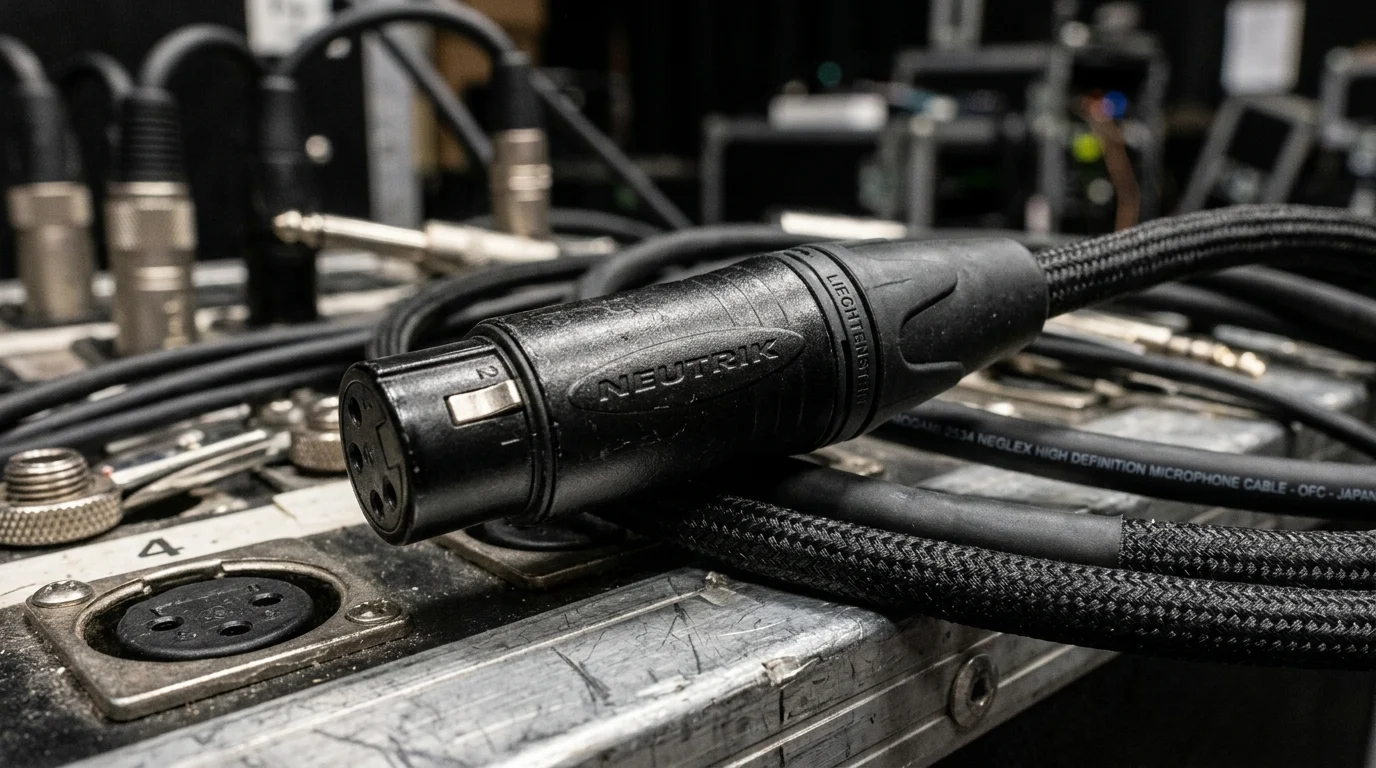
Evaluating the right audio cable requires a deep understanding of the physical and electrical properties that dictate signal transfer. Stage environments demand specific configurations to handle everything from microvolt-level microphone signals to high-amperage amplifier outputs, requiring buyers to scrutinize core technical specifications.
Conductors, Shielding, Capacitance, and Impedance
The core of any audio cable is its conductor, typically constructed from Oxygen-Free Copper (OFC) to ensure maximum conductivity and resistance to internal corrosion. For line-level and microphone signals, lower capacitance is preferred to prevent high-frequency loss, while impedance matching is critical for digital lines.
Shielding is equally vital for defending the conductor against EMI and RFI. The choice of shielding impacts both signal purity and mechanical flexibility on stage.
| Shielding Type | Coverage | Flexibility | EMI/RFI Rejection | Best Application |
|---|---|---|---|---|
| Braided Copper | 95% | High | Excellent | Stage microphones, frequent handling |
| Serve / Spiral | 90% | Very High | Good | Instruments, patch cables |
| Foil (Al/Mylar) | 100% | Low | Excellent (High Freq) | Permanent installations, multicore snakes |
Cable Types: Balanced, Unbalanced, Speaker, Digital, and Network
Audio cables are categorized by the type of signal they carry. Balanced cables (utilizing XLR or TRS connectors) carry two identical copies of the signal in reverse polarity, allowing the receiving equipment to cancel out induced noise via common-mode rejection. Unbalanced cables (TS or RCA connectors) lack this secondary line, making them highly susceptible to interference over distances.
Speaker cables operate differently, carrying high-voltage, high-current amplified signals. They do not require shielding but demand thick conductors—typically 12 AWG or 10 AWG for amplifier outputs exceeding 1000 watts—to minimize resistance. Conversely, modern network audio relies on digital cables like Cat5e or Cat6a. For Dante or AVB protocols, a shielded Cat6a cable with a 500 MHz bandwidth is standard for ensuring zero-packet-loss transmission in dense RF environments.
Connectors, Jackets, and Flex Life
The mechanical components of a cable determine its survivability. Connectors dictate contact resistance and mating cycles. Silver-plated contacts offer exceptionally low initial contact resistance (approximately 3 milliohms) but tarnish over time, whereas gold-plated contacts resist corrosion, making them ideal for humid or outdoor environments.
Cable jackets provide the primary defense against physical damage. Polyvinyl Chloride (PVC) is the industry standard due to its flexibility and cost-effectiveness, but Polyurethane (PUR) is often specified for extreme touring environments due to its superior resistance to abrasion, tearing, and temperature fluctuations. High-end touring cables are engineered for a flex life exceeding 10,000 bending cycles, ensuring the internal conductors do not snap under the rigors of daily stage deployment.
How to Compare Audio Cable Options
Procurement managers and audio engineers must navigate a saturated market of cabling products. Establishing objective comparison metrics is essential to separate marketing claims from verifiable performance capabilities, ensuring the selected inventory aligns with the physical demands of the production.
Key Evaluation Criteria
When evaluating options, buyers should prioritize gauge, shielding density, and connector pedigree. For speaker cables specifically, the relationship between wire gauge (AWG), speaker impedance, and cable length is a rigid mathematical constraint. Using a cable that is too thin for a long run increases resistance, which degrades the amplifier's damping factor and results in a loss of low-frequency control.
| Wire Gauge (AWG) | Max Length @ 8 Ohms | Max Length @ 4 Ohms | Typical Application |
|---|---|---|---|
| 16 AWG | 50 ft (15.2m) | 25 ft (7.6m) | Low-power stage monitors |
| 14 AWG | 80 ft (24.3m) | 40 ft (12.1m) | Standard PA speakers |
| 12 AWG | 120 ft (36.5m) | 60 ft (18.2m) | High-power subwoofers |
| 10 AWG | 200 ft (60.9m) | 100 ft (30.4m) | Long-run line arrays |
Lifecycle Cost, Repairability, and Risk
Evaluating cables purely on initial purchase price is a flawed procurement strategy. Lifecycle costing shifts the focus to Total Cost of Ownership (TCO). While premium cables may carry an upfront cost that is 200% to 300% higher than budget alternatives, their operational lifespan is often up to ten times longer.
Repairability is a crucial factor in this TCO calculation. Cables featuring molded or potted connectors represent a 100% financial loss upon failure, as they cannot be serviced. Conversely, cables utilizing industry-standard serviceable connectors with chuck-type strain relief (capable of withstanding over 30 kg of tensile pull-out force) allow technicians to quickly resolder a broken connection, preserving the asset and minimizing replacement costs.
A Practical Process for Selecting Audio Cables
Implementing a standardized procurement and deployment protocol ensures that live event productions operate with maximum efficiency and minimal technical debt. A structured approach removes guesswork and guarantees that the right audio cable is always available for the specific task at hand.
Assess Cable Runs, Interference, and Load Requirements
Routing paths and environmental factors dictate the exact specifications required for an event. Unbalanced runs (such as those from guitars to amplifiers) must be strictly restricted to under 15 feet (4.5 meters) to prevent high-frequency roll-off and unacceptable noise floors. In contrast, low-impedance balanced microphone lines can easily run 300 feet (90 meters) without noticeable signal degradation.
Interference mapping is also required. If audio cables must cross lighting power feeds, they should do so at 90-degree angles to minimize electromagnetic coupling. Furthermore, load requirements must be calculated for all passive speaker runs to ensure the selected AWG can handle the continuous RMS wattage of the amplifier without thermal overload or voltage drops.
Use a Step-by-Step Selection Path
A systematic selection path begins with standardizing core inventory to reduce complexity. Rather than stocking a chaotic assortment of lengths, productions should standardize on designated increments (e.g., 10ft, 25ft, and 50ft for microphones).
Next, engineers should utilize multicore snakes and stage boxes to consolidate long runs from the stage to the Front of House (FOH) console. Transitioning from heavy analog copper multipin snakes to digital stage boxes connected via a single tactical Cat6a line dramatically reduces weight, deployment time, and the potential for individual channel failures.
Test, Label, and Standardize
Quality control demands rigorous testing protocols before, during, and after a production. Using a digital multimeter (DMM) or a dedicated cable tester is mandatory for verifying continuity and phase accuracy. Resistance across a newly soldered connector should consistently measure below 0.05 ohms; anything higher indicates a cold solder joint or deteriorating contact.
Finally, standardizing an inventory requires robust labeling. Utilizing transparent heat-shrink tubing over custom labels prevents text from wearing off during use. Advanced production houses increasingly deploy barcode or RFID tags beneath the heat-shrink, allowing inventory management software to track deployment history, flag cables that fail testing, and monitor asset depreciation across the lifecycle of the equipment.
Key Takeaways
- The most important conclusions and rationale for Right Audio Cable
- Specs, compliance, and risk checks worth validating before you commit
- Practical next steps and caveats readers can apply immediately
Frequently Asked Questions
What cable type is best for stage microphones and long analog runs?
Use balanced XLR microphone cables with OFC conductors, low capacitance, and braided shielding. They reject stage noise better than unbalanced cables and stay reliable over long runs.
Can I use an instrument cable as a speaker cable?
No. Speaker outputs need unshielded, heavier-gauge cable such as 12 AWG or 10 AWG for high-power amps. Instrument cables can overheat and cause signal loss or equipment damage.
How do I choose a cable for AES/EBU or Dante systems?
Match the protocol. Use 110-ohm XLR cable for AES/EBU and shielded Cat6a for Dante in busy stage environments. Correct impedance helps prevent dropouts, jitter, and data errors.
Which shielding is best for live event cables?
Braided copper shielding is usually the best all-around choice for touring and stage use. It offers strong EMI/RFI rejection and better durability than foil in cables that are moved often.
Can JINGYI provide custom cables for livehouses, festivals, or private labels?
Yes. JINGYI offers OEM/ODM custom cable production, premade pro-audio cables, and private label support for venues, rental companies, studios, and festival systems.


